Showing posts with label kitchen reuse. Show all posts

Thursday, 2 July 2020

The Power is Yours!

I've never been a big fan of practices that are considered wasteful or that may be harmful to the environment.  Maybe that's because I grew up watching Captain Planet guard the earth and The Raccoons protect the forest.  I was taught to be aware of pollution and to be a good global citizen by putting litter in its place. 
Graphic by Charlene

As a kid, I was lucky enough to participate in programs and initiatives that supported the environment.  I took school field trips to logging sites, where we helped forestry services with tree planting.  I still remember how exhilarating it felt to physically place those tiny, baby trees in their new earthy homes.  I thoroughly enjoyed the fresh air, exercise, and the opportunity to make a difference.   

Since the invention of the internet, it has become exponentially easier to learn about and discuss our impact on this earth.  Knowledge is being shared across the globe every day.  While this has certainly been helpful, it's also made it clear that there's so much more work to be done. 

Graphic by Charlene

There are many simple and accessible changes that I’ve made to lessen my impact on our planet.  When I learn a new way to complete an everyday task that presents an environmentally-friendly alternative to the norm, I try to adjust my lifestyle.  I'd like to share a few practices that I've adopted.


Low-Impact Dusting


Let’s face it, dust bunnies are everywhere!  They congregate in corners and hide behind doors.  If you’re not careful, they invite all their friends and family over for a party.  My house regularly hosts conventions for a small army of the biggest dust bunnies known to man*.
*not scientifically proven

I’ve found vacuuming tends to leave a trace amount of dust behind, that's particularly noticeable on hard surfaces.  So I utilize a few tools that don’t produce the waste involved with disposable dusting products:
  • reusable container
  • cloth that’s not too fancy
  • small amount of tap water
For the container, I typically rinse and reuse a small plastic butter/margarine tub, but you could use the dish or bucket of your choice.  If you don't have the right container at home, the Reuse Centre carries an assortment of types and sizes, based on donations.  Reusable cloths are widely available, and there are many DIY options too.  For example, old holey t-shirts can be cut up into small squares, or you may already have a selection of dishcloths ready for retirement.  Face towels are good options too.  If you choose a reusable cloth, the impact can be further minimized by removing/rinsing as much dirt or grime as you can using your water bin, then tossing the cloth into a wash cycle with other clothes.  When I'm done dusting, I "donate" the dirty water to my compost farm!


Cardboard Creativity


I prefer cardboard to plastic, but end up with a lot of it at home!  I've begun shredding smaller packages and spreading them in my compost farm.  For those without compost worms, cardboard containers make great reuse!  Think... wrapping for presents, packaging for parcels, even everyday organization around the house.  Use cardboard to separate drawer contents and keep small objects contained.  Cardboard boxes are also great if you plan to move!


Have you discovered a great way to reduce, reuse and save?  


Please leave us a comment and share your ideas for supporting the environment!


Submission and artwork by Charlene (Volunteer)

Wednesday, 17 June 2020

Chef Saves

Today, let’s spend some time in the kitchen. No, I am not cooking a specific dish. I am going to share how simple changes in the kitchen can have an important and significant impact. Among some of the things wasted in our day-to-day life, food waste is a huge problem.The statistics say that 58% of all food produced in Canada is lost or wasted (Second Harvest and VCMI, 2019). 

An excellent place to start reducing food waste is to observe and make a list of what food and beverage items are being regularly thrown away in your home. This list will highlight if something is routinely being wasted. Once you make your list of commonly wasted items, find ideas on how to repurpose or store food instead of tossing it. Ask yourself “could these items be purchased in smaller quantities, be repurposed to avoid being thrown away, or be easily composted?” 

Vegetable scraps 
  • Use left-over veggie scraps to prepare a nice and healthy broth. Save up odds and ends of vegetables whenever you chop and cook with them. When you have enough scraps, throw everything in a pot and add water, stir and bring to a light boil. Then strain the mixture and store the broth in jars in your freezer. 
  • Bake or stir fry potato skins, add some cheese and serve as a side dish. This one is my husband’s favorite dishes.

Stale Bread
  • Another common ‘waste’ in our kitchen is stale bread and bread crusts. I make bread crumbs with these: I put them into a food processor, pulse them and store the crumbs in a jar for future use.

Bread crusts turned into bread crumb


Herbs
  • I used to throw away more than half of my fresh herbs - coriander, parsley, and mint leaves - but have learned a great way to store them for longer use. I chop the leaves and freeze them in an ice cube tray. As I need them, I take them out to defrost, and use.

Herbs stored this way can stay much longer

Tea and Coffee 
  • My mother has beautiful indoor plants and credits this success to used tea leaves. Once tea is prepared, the steeped tea leaves (not containing sugar or dairy) are placed directly in the pot. The plants benefit from the extra nutrients. 
  • Did you know that some tea bags have plastic in them? Steeping loose tea leaves in boiling water is the best way to avoid the added plastic. 
  • Use coffee grinds as a deodorizer in the trash can or refrigerator. You can also spread them in your yard as a natural pest-repellent.

 Tea leaves used as plant nutrients

Fruits
  • Lemon and orange peels make great scrubs for your face and body. Dry the peels and grind them to make a fine powder and use it as a scrub. Some people also make facial creams with orange peels.
  • Banana peels are rich in nutrients, so instead of throwing them away, try adding them to smoothies and shakes. You can also mix them in flour and bake or fry them for a tasty snack. You can use ripe banana flesh as a face mask for a soft and fresh look. 
  • Instead of throwing away bruised fruit, toss them into a salad or make popsicles.

The possibilities are endless with what can be done to avoid food waste. I learned recently from a friend that she even grinds eggshells into a powder and uses it as a calcium supplement for her dogs. Please check with your veterinarian before giving this a try.

For potential food waste that you cannot otherwise repurpose or consume, consider composting. If the idea of home composting is new to you, learn more here.

No discussion about kitchen waste can be complete without talking about reducing the use of plastics. Try and carry your reusable bags for grocery shopping. Nowadays, good reusable cloth bags for produce are available in the market. You can replace plastic containers with glass jars, paper, and cloth bags. It’s an investment worth making and an impact you can make towards saving our planet. Many stores still sell fruits and veggies in single-use plastic wraps or boxes, but you can try and avoid buying such boxes if other options are available. Buying plastic-free groceries is hard, and you cannot always win, but it’s important to do your best.

Let us make these small important changes in how we shop for, store and use groceries to reduce food waste. Let us pledge towards a zero-waste or low-waste  lifestyle, starting with the kitchen.

Photos and Submission by Sunanda (Volunteer)

Tuesday, 8 October 2019

Reuse Ideas for the Kitchen


September is the perfect month for establishing new routines and getting into a groove after the chaos of summer. For me personally, September was also about adjusting to a new home after a big move.

Food, as always, is a big theme in this reorganization period. So, I thought I’d share my favourite ways (as well as some aspirational ways) to reuse everyday items. Ever-present yogurt containers and glass jars aren’t just for leftover lasagna, they can be used proactively to reduce waste!

I love to drink smoothies in the morning and I recently discovered Earth’s General Store on the eastern end of Whyte Ave. Earth’s General Store  encourages customers to use reusable containers for bulk products like nuts and seeds in a similar way to Bulk Barn (my true love). They also carry bulk products like frozen fruit, peanut butter and pierogies. Pierogies are, arguably, unrelated to smoothies, but they’re also my favourite ‘easy meal’ to keep in the freezer. Old ice cream pails or margarine tubs work perfectly for easy-stacking freezer grabs and I am so so excited to be free from the single-use packaging for these staples!

Truth bomb here: I spend way too much time (and probably money) at La Boule. All my time there sipping teas and munching on croissants has made me realize how often I buy bagged bread from the grocery store when I could be pursuing better crafted loaves sans plastic packaging. So here’s the dreamy bit—I’m going to make my own fabric bread bag. Sewing has never been my forte, but I think I’m up for the challenge.  Whether from my own home or from the Reuse Centre, giving old fabrics a new life not only keeps them out of the landfill, it also means that I won’t be wasting plastic bags for my bread on an almost-weekly basis. It might even allow me to visit new bakeries all around the city to find bread for my bread bag!

Last but not least: I’ve grown extremely affectionate about Veg in YEG. For those who have not heard of it, this is an urban farming group near the University of Alberta. They’re great for a couple of reasons: firstly, I can bring my organics and compostables and use their composting facility (thank you!); secondly, they sell incredible produce without the use of wasteful packaging that can be picked up or delivered to nearby areas. They operate on a pay-what-you-want structure which is such an important thing to have so near to the University (and in general). My favourite experience is Nicole showing up to my door with a reusable container full of luscious greens that I simply transfer to my own glass jar for storage. My greens stay fresh for longer and we forgo any wasteful packaging.  Win, win!


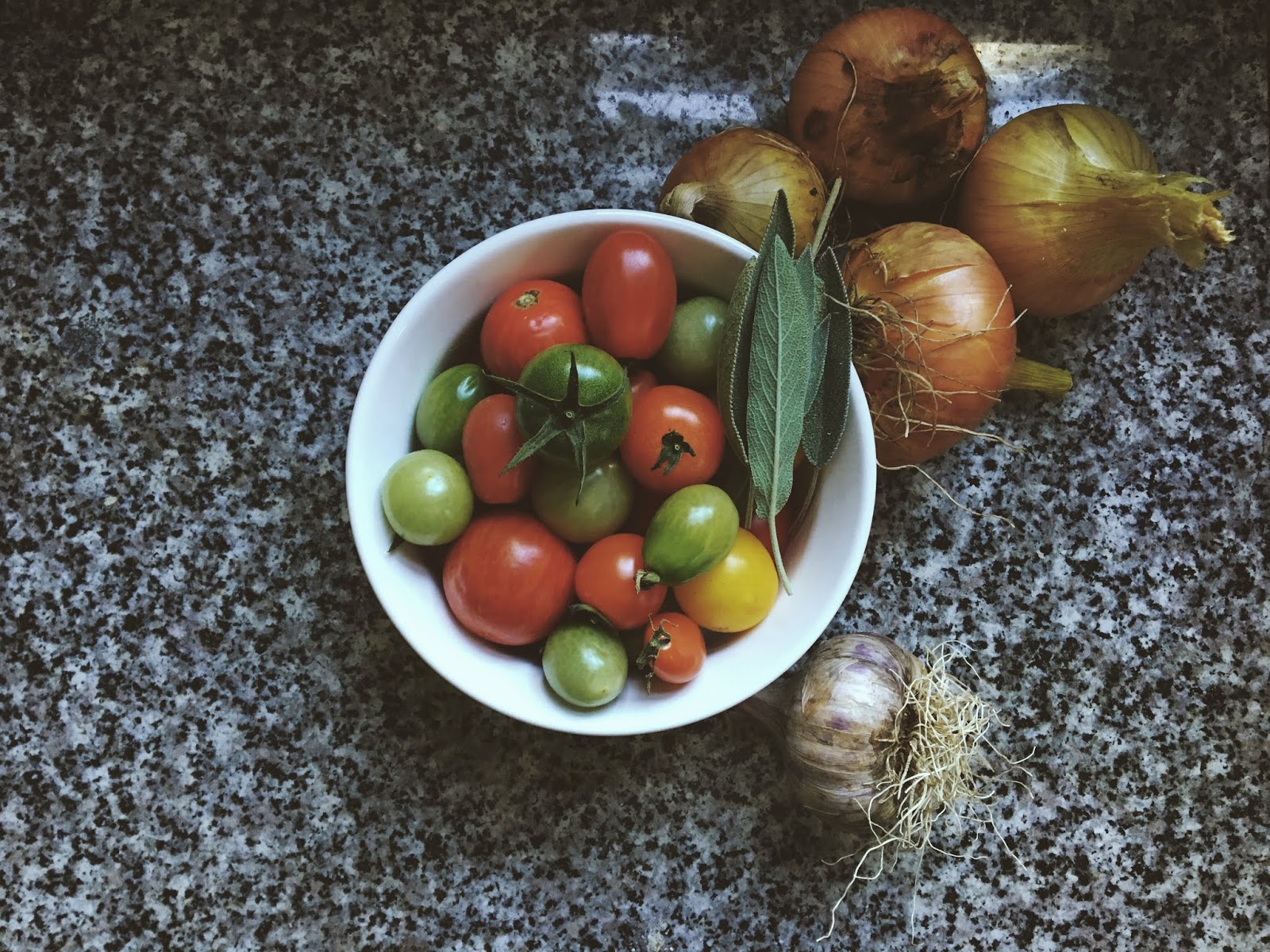
My more recent deliveries have included garlic, onions, tomatoes, kale, beets, sage, oregano, thyme and a special blend of herbs for making tea.


Nicole also let me take a sweet rainy-day photo of her--what an actual angel.

Cheers! And happy harvest season.

Photos & Submission by Jess B (Volunteer)