Showing posts with label Reduce. Show all posts

Tuesday, 11 September 2018

5 Tips and Tricks Before You Thrift

Are you tired of your style? Would you prefer a more sustainable way to shop? Are your funds limited? If you answered yes to any or all of these questions, you're in luck! Thrift shopping is the answer to your fashion dilemma! However, before you go rushing to the nearest thrift store, here are five tips and tricks to guide you through thrift shopping.


                                                         Photo: Cindy Caturao


1. Set a Budget

Limit your spending! With prices reduced to almost half, sometimes even three quarters of the original price, it's quite easy to get carried away and buy clothes and furniture that you don't necessarily need. Ask yourself: Do I need it? Will I actually use it? Is it worth it? Setting a budget will help you to not only narrow down the things that you need but also keep your spending in check. 

2. Shop Around 

Edmonton offers a variety of consignment boutiques, thrift shops, and many second-hand stores. Various neighborhoods will also carry different items. I suggest going to multiple locations for an eclectic mix to shop from.

3. Sign up for memberships 

I understand, there is nothing more annoying than constantly receiving promotions, newsletters and just overall spam mail from different companies but sometimes it's worth it to subscribe. Occasionally, places such as Goodwill and Value Village will email members 40-50% off coupons. 

4. Shop with an open mind

Refrain from sticking to one area of the store. The beauty of thrift shopping is that most of the time, the items that you find are from the most unexpected sections of the store. Keep your options and selections ample and explore different areas of the store outside of your comfort zone!

5. D.I.Y.

Occasionally, you may find a garment that's not your ideal size or style. Making some quick and easy alterations allows you to see beyond the original purpose of the item. It opens up the potential and possibilities to reuse and repurpose garments. 

Thrift shopping is a sustainable way to dress without breaking the bank. It promotes reusing and repurposing garments that might otherwise end up in landfill creating more waste. Lessen your carbon footprint and shop at a thrift store. You never know what you might find!


                                                                                       - Cindy (Volunteer)

Thursday, 16 August 2018

How to Throw a Waste-Free Party

Summer is full of weekend get togethers and backyard barbeques. All these parties can create a lot of excess waste and garbage. But it doesn’t have to be that way. There are many ways to reduce or eliminate waste at your next summer party. Here are some tips.

Use reusable plates, cutlery and napkins 
    • While disposable dinnerware may be tempting to use for convenience, it creates a lot of extra garbage. Most of these items are plastic, Styrofoam, or coated with a water-resistant finish so they are not recyclable. If you must use disposable items try to find ones that are labelled as Certified Compostable. 
    • An easy alternative to disposable plates, cups, and cutlery is to use your own dishes and flatware. What’s that? You don’t have enough? Ask your guests to bring some. Having an assortment of dishes creates an eclectic fun atmosphere for the party. 
    • Along the same idea of using reusable dinnerware, the same applies to drinkware. Skip cans and bottles for beverages and serve drinks from pitchers or jugs. This will prevent having to recycle empty bottles and cans. It will also allow guests to have as much or as little water/juice as they want; they aren’t stuck with finishing the entire bottle or can or having to dump out the leftovers. Remember to use reusable cups and glasses too! 
    • Worried about washing all those dishes? Most of the individual plates, glasses, and cutlery can go in the dishwasher. That just leaves the serving dishes, which will have to be washed by hand. This is not such a terrible thing! Recruit a couple of your guests to stay later and help. This is a great opportunity to reflect on the party and have one-on-one conversations with guests that you may not have had a chance to chat with earlier. 
Ask guests to RSVP and confirm numbers
    • Knowing how many people to expect is important in determining how much food and beverage is needed and reduces the amount of leftovers after the party. Whether you send out a formal invite or a casual instant message, try to get an accurate number of the guests you are expecting. 
    • For quantity planning, check out the spruce for tips on planning quantities of food needed.
Have guests bring reusable containers for leftovers, or try a potluck, instead
    • This will reduce the amount of food that is wasted. Guests can take home a little bit of everything and have lunch or dinner for the next day. If you choose potluck style, then guests can take home their individual leftovers and you aren’t stuck with all of the remaining food.

Skip paper invitations
    • There are lots of great websites where you can create custom invitations for your party and send them via email or text message. These sites allow you track RSVPs, set up potluck instructions, plus loads of other additional features. Punchbowl is one that I like. It’s very user friendly and offers a variety of fun templates for any theme.

Serve seasonal, minimally-packaged bulk food
    • Purchase seasonal local produce and prepare and cut it yourself. This will reduce a lot of plastic waste from pre-packaged fruit and vegetable trays.
    • Purchase deli meat, olives, nuts, and other snacks in bulk. This will not only save you money but will minimize having to toss empty bags and packaging.

Do you have any other ideas for hosting a waste-free party? Comment below with your thoughts and ideas.

Vanessa (Staff)

Wednesday, 11 October 2017

Fused Plastic Bag Tutorial

Despite an unreasonably large stash of reusable fabric shopping bags, I somehow continue to collect plastic disposable bags. We recently blogged about 10 Disposables to Toss From Your Kitchen, so I am taking a renewed look at my waste and making a better effort to reduce my consumption. Meanwhile, I am experimenting with what to do with this collection of plastic bags.

Pinterest is a haven for creative repurposing ideas. Fusing several pieces of plastic together with an iron has been pinned in my account several times over. It was finally time to find out for myself if those crafty pinners are leading me down a path of melted messiness or fashionable eco-consciousness. Therefore, I tried making my own fused plastic bag!

I started by cutting off the seams of several plastic bags and laying each piece flat.
My plastic bags were all different sizes, colours and store brands.
Photo: Ellen Hanna
I opted to hide any logos or writing by keeping the plain side facing out. 
Photo: Ellen Hanna
I matched the various sizes until I had a stack of 8 layers. I placed a towel on the table for protection and a piece of parchment paper on the very top to protect the iron. Then, I pressed firmly until the layers were fused, but not melted away. My iron doesn't have specific temperature settings (or even helpful fabric icons to guide me) but I found the mid-temperature was best. The plastic shrinks considerably, so don't be alarmed!
I needed five pieces to create one bag: two sides, a front, a back and a bottom. 
Photo: Ellen Hanna
I repeated this process several times until I had five pieces of fused plastic sheets. At this point, I decided on measurements for my bag based on the largest size of sheet available.
I decided on the sizing based on measurements after my iron shrunk the fused bags. 
Photo: Ellen Hanna
Using a rotary cutter and a quilting square, I cut the pieces down to their final sizes.

Pieces of the bag, ready to be sewn.
Photo: Ellen Hanna
Then for the fun part! I used a colourful thread to sew the edges together. I don't think this material would lend well to being flipped inside out, so I opted for a visible stitch. I used the widest zig zag stitch, fairly tight. I held the stitch as close to the outer edge as possible.
Visible stitching with red thread. Photo: Ellen Hanna

Next, I pinned two pieces together, right sides facing out and sewed a zig zag stitch straight down. I sewed this on all four edges until the walls of the bag were created. 
The form of the bag beginning to take shape.
Photo: Ellen Hanna
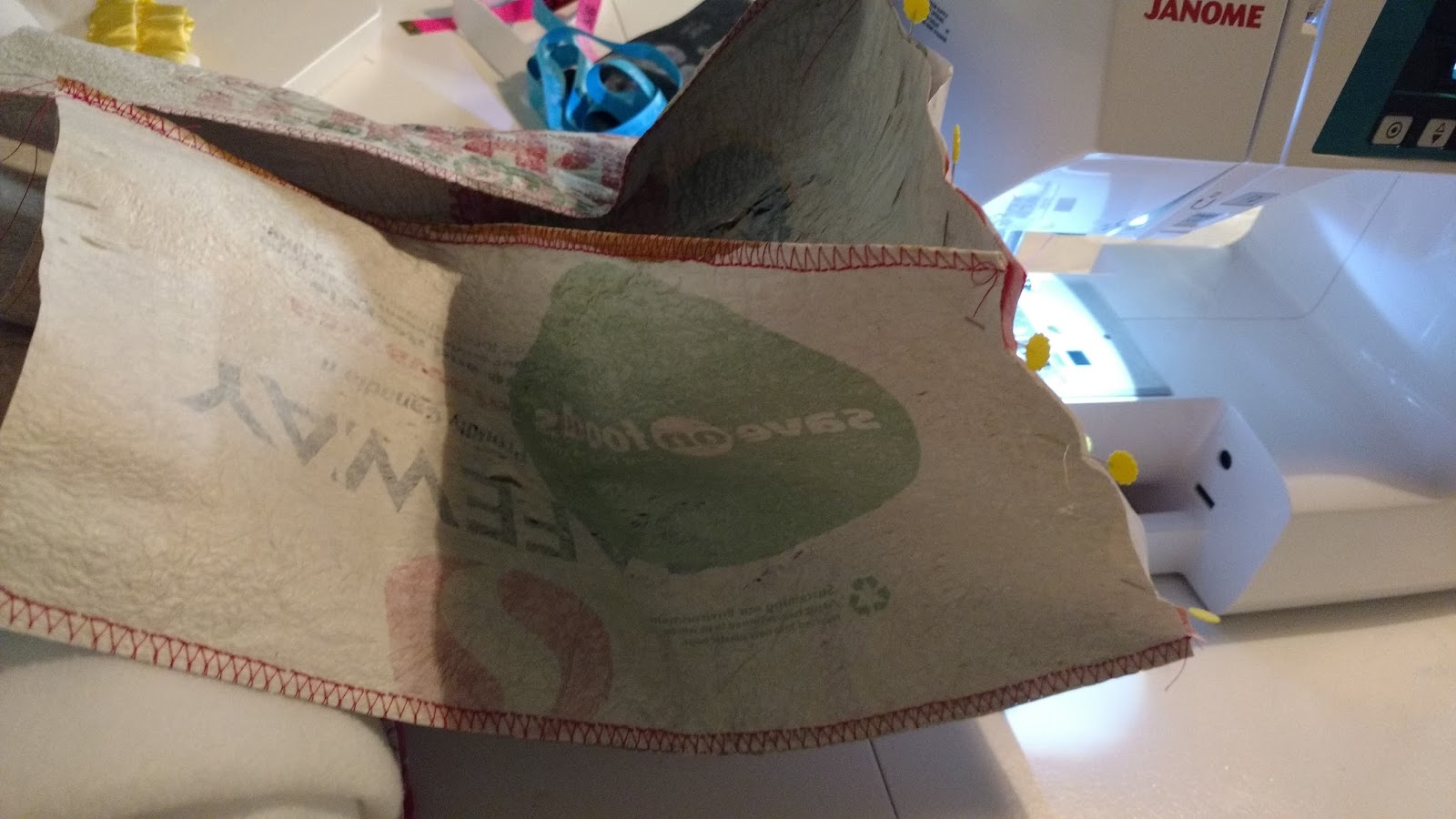
The next step was a bit tricky, so I had to make sure to line things up carefully and use pins! I placed the bottom piece in place, then pinched the edges together in place, while using pins to secure. I picked a spot and started sewing a continuous zig zag stitch around the entire bottom. I was careful to backstitch in the corners to reinforce the bottom of the bag. 
The material is stiff; therefore, lots of pins are needed to keep the bag in place. 
Photo: Ellen Hanna
Stitching around the entire bottom of the bag, backstitching to reinforce in tricky places.
Photo: Ellen Hanna 
The last step was sewing on handles to be able to carry the bag. I decided on using fabric scraps instead of fused plastic for a more comfortable feel. I used a visible stitching for the handle which was similar to the bag. I simply folded a long scrap piece, ironed well and then zig zag stitched down the middle to hold in place. 
Simple fabric handles.
Photo: Ellen Hanna
For a more polished look, another option is to stitch a straight stitch down a folded piece to create a tube, then flip the tube inside out to make a strap without a giant zig zag stitch visible in the middle. However, I worked towards a "shabby chic" look and didn't mind the stitching showing or the rough edges on the inside. 
Fabric handles sewn to the inside of the bag.
Photo: Ellen Hanna
I made this in haste while my brother was visiting with his family. It was meant as a gift and I wanted to give it to them before they flew home. As it turns out, they have been using it as a diaper bag non-stop for the past 4 months. It has been dragged around everywhere, while being emptied and filled endlessly. It is still in great condition; therefore, this bag made with fused plastic bags is a real winner for strength! 
Not too shabby for a first effort!
Photo: Ellen Hanna
Happy crafting!
Update: Here's the bag after a few months of use, still going strong!


Photo: Tom Ewart
Photo: Tom Ewart


Photo: Tom Ewart
Photo: Tom Ewart

Friday, 5 May 2017

Edmontonians Breathe New Life into Pre-Loved Clothes

This past weekend, Change of Clothes hosted their third annual Clothing Swap, Repairathon, Upcycling, and Panelists event, the culmination of a week of Fashion Revolution events. Change of Clothes shares in the Fashion Revolution goals of awareness, positivity, and participation by providing a space for Edmontonians to extend the lives of their wardrobes through mending, swapping, upcycling, and donating. Change of Clothes also shares in the Reuse Centre's goals of diverting waste from landfills; in only two years, Change of Clothes has processed over 700 pounds of clothing through repair, swapping, upcycling, and donation!

When Claire Theaker-Brown returned to Edmonton after living in China, she felt that there was a lack of community focus around sustainable fashion. Edmonton already had the repairathon, random clothing swaps, craftspeople focusing on upcycling, and recipients of clothing donations; however, there lacked a hub to bring all of these people together. This sparked Change of Clothes, a space for makers to share knowledge and resources while fostering a community where shoppers and brands are brought together in one physical space.

This year's event kicked off with a panel discussion featuring: Brittany Nugent of the Publicity Room, representing the consumer; Crystal Tracy, the creator of beautiful children's clothing at Sweet Jane Studio; Janna Stewart, owner and operator of Cinder & Smoke women's fashion and the newly created Arturo Denim; and Change of Clothes co-founder Claire Theaker-Brown, also founder of Flatter:Me Belts. The panel provided an opportunity to hear about the struggles and successes of makers within this community of sustainable fashion and allowed members of the public to engage in honest discussion.

Wading into the waters of sustainable fashion can be intimidating. As Claire aptly points out, there are two words that really freak people out: "sustainable" and "fashion." But it doesn't need to be so complex. Fashion doesn't need to be fancy, expensive, or exclusive. And sustainability is about "progress, not perfection", as Claire often repeats throughout the panel discussion. One sure way to know you're making a difference is simply by extending the life of any consumable, offers Claire.

A great example of this was included in the day's activities. The House of Sew, Jillijade Jewellery, and Makers & Mentors were on hand to help participants upcycle jewelry and turn old t-shirts into fashionable headbands, as modeled here by participant Adam.

Kristen, an Edmontonian attending the event, believes we already have so much and don't need to consume more. "Sharing is caring," she jokes, explaining a sense of joy in the swap when you release, reminding yourself to let it go. She is no stranger to swapping. In university, she and her friends created what they called "The Sisterhood of the Travelling Dress", by time-sharing one versatile dress among the group. This spin on renting is a tenet of the Fashion Revolution's 7 Rs: reduce, reuse, recycle, rent, research, repurpose, repair.

A die-hard vintage hunter and self-professed denim enthusiast, Piyush frequently circulates through Edmonton's second-hand clothing venues. He sees the value in pre-loved clothes and has a keen eye for particular textiles, patterns, and brands. Piyush has fostered a close relationship with his tailor who helps him see his creative ideas to fruition, whether they be simple hemming or outlandish DIY concepts. At this year's event, he made use of the repairathon to add a patch, created by a Toronto designer that he recently acquired on Etsy, to a denim jacket. If you don't have the skill, resources, or interest in sewing yourself, take a page from Piyush's book and utilize the community around you!

Kassia, a veggie lifestyle blogger, gushes about the Change of Clothes yearly event, claiming it's the best swap in the city! She not only feels better giving her pre-loved clothes a second life, but maintains that some of her most valued pieces have come from this particular swap. Kassia explains that as a poor student, she sought to fulfill her glam style with the cheapest, most accessible stuff. What she noticed was instead a closet full of junk. As she "grew up" (her words!) she began leading a plant-based diet and began researching every aspect of her life, realizing that cheap clothes were not necessarily more economical.

This is the second time I've heard this idea, as panelist Brittany Nugent affirmed, "I don't make enough money to buy cheap clothes." She was speaking of her own journey into sustainable fashion and I admit, the concept took my brain a few beats to understand. The idea is pretty simple: buying cheap clothes is not only unsustainable, but it's throwing your own money away. Cost-wise, it makes more sense to buy fewer items, being more intentional and less impulsive with our purchases. Each piece may cost more but by buying quality items, we ensure a longer lifespan. Worried about the shelf-life of fashion trends? That's where repurposing (upcycling) and swapping come in handy. Other options include renting current fashions or vintage shopping.

What's more, intentional shopping, by design, eliminates impulsivity. It requires research and thought. It requires asking the difficult questions and possibly writing a letter to your favourite brands asking who made the clothes. As Claire explained during the panel discussion, for her, it's less about where the clothes are made and more about who made them. Whatever your main goals, as a consumer, the power is yours. "I'm voting with my dollars," says Brittany who makes the decision to spend with retailers when she knows the story behind the clothes. "We've lost the value of our clothes," says Janna. It's time we rethink this.

These are the exact reasons Chelsey mends her damaged clothing. She believes repairing a favourite piece not only prolongs its life and allows her to continue enjoying it, but she also finds it much cheaper than buying a new item. She focuses on selecting clothes that will last year after year to get their full wear and mends items when necessary.

Claire asserts, "building a sustainable fashion community is not going to happen out of guilt." Happily, Change of Clothes has provided a space to meet the motivations of anyone, from a sense of duty to simple economics. And with numbers growing steadily each year, Claire believes there could be a need for the event to run twice a year. They've got a great space at the Ritchie Community Hall and a great base of volunteers. So if you're interested in learning more or engaging with the community, reach out by tweet or instagram!

- Ellen (Volunteer)

Friday, 13 January 2017

New Year's Reuse Resolutions


We're in the second week of 2017 and any resolutions that you made are probably still pretty fresh in your mind. This year, some of our blog team members decided to come up with our own reuse themed resolutions. Each of us created an attainable resolution to reduce some of our negative environmental impacts and change some of our wasteful habits. Here's a look at our reuse resolutions.


Sarah

One of my resolutions this year is to eliminate the use of paper towels and paper napkins in my home. I've stocked my kitchen with rags for wiping up spills and messes, and I made a bunch of fabric napkins out of old cotton scraps. Both of these items are in visible, easy-to-reach spots, which means I'll think of them before I grab their disposable alternatives. 

Interested in making your own cloth napkins? Check DIY Network for a simple tutorial.

Image source: diy network

Vanessa

My reuse resolution for 2017 is to reduce the number of disposable coffee cups that I use. I love a nice hot beverage on these cold Edmonton winter mornings! I try as much as possible to brew my coffee or tea at home and take it to go in a travel mug but there are times that I either run out of time in the morning or just want to treat myself. It's on these occasions that I, more times than not, forget my travel mug at home. Then I always feel guilty when I have to toss my empty cup in the trash. This year, I'm going to make a bigger effort to pack a travel mug with me and have it handy for when I stop at my favourite coffee shop.


Photo credit: Vanessa
Siao

My resolution for this year is to borrow, offer, and buy used. I want to make the conscious effort to consider these options thoroughly before consuming non-essentials. If I was picking up a new hobby, do I know of any friends that would be willing to loan me their tools or old sporting equipment? On the same note, I want to openly offer my unused items for friends and family to use rather than have them sit idly in storage. If there are no extras to be borrowed, then I want to exhaust all options of used purchases before I buy new.

Do you have a reuse resolution? Share it in the comments section.

*Happy New Year 2017 image provided by Gallery


Tuesday, 3 June 2014

Keep your Garden Green: Reusing in your Backyard

It's Spring again (finally!) and that means that across the city, people are getting outside, waking up their yards after a long sleep, and getting ready for the gardening season.

We live in a rough climate, and chances are that your planters, pots, trellises and stakes are all a little worse for wear if you've left them outside over the winter. Garden centres do booming business this time of year, and not just on plants, as folks replace their old containers, tools, and garden decorations.  New items might make our backyards and flowerbeds look beautiful, but with a little creativity, you can have a gorgeous garden for less, AND reduce your environmental impact.

Whether you've got a sprawling backyard or a few manageable pots on your balcony, here are some of my favourite ideas for reuse in your planting spaces this summer:


Get creative with planters.

There is no rule that says you must grow your plants in pots. As a former florist, I can tell you that anything that holds dirt will do, as long as you make a few considerations for plant health. Don't use metals that will rust unless you have a liner in place, and make sure your plants have adequate drainage. This means that if your container doesn't have holes in the bottom, a) make some or b) fill the bottom inch or two with rocks and take care not to over water.

Check out this site for 30 great reuse and DIY planter ideas.

Use found or reused lumber for wood projects.

Want to know how to build this awesome walkway? Check out the tutorial at Funky Junk Interiors.

Pallets are a reuse gardener's best friend. You can make furniture, planters, or use the wood to make fences or square off garden beds. Here in Edmonton, Habitat for Humanity's ReStore is a great place to get re-use or cast-off construction materials.


Make your own garden markers.

From popsicle sticks to venetian blinds, juice can lids to painted stones, there are a ton of ways to make markers for your plants. These are a great way to get the whole family involved in taking care of a home garden.

Check out Housing a Forest's 27 DIY Garden Markers for a list of tutorials.


Don't forget the critters.

You can attract birds and other wildlife to your outdoor spaces with funky, functional feeders and houses. Not only will they make your outdoor spaces look pretty, but attracting wildlife can improve your garden experience by keeping your insect and pest levels down.

Check out these 23 upcycled bird feeder ideas and this list of 20 birdhouse tutorials.

You can also build an easy bee house out of reuse materials. These little houses attract solitary pollinators; these bees will improve your flowerbeds without the aggressive behaviour of hive-bees.

Compost!

This isn't reuse in the way we typically think of it, but composting your organic materials, from veggie peelings and rotten fruit, to kleenex and dryer lint, is one of the best ways that you can reduce your garden's environmental footprint.
Not only will you be returning valuable nutrients to the soil, but you'll eliminate the need to use chemical fertilizers on your plants and produce.

These are just a small number of reuse ideas for your outdoor spaces this summer; the possibilities really are endless. Get creative, and share your favourite ideas for reuse in the garden in the comments below!


-Sarah (Volunteer)

Thursday, 26 December 2013

Reuse tips to get you from Christmas to New Year

It's that time again - the season of peace, love, and the spirit of giving.  Unfortunately, it's also the season of increased waste and energy consumption.  Sometimes we get a little carried away during the holidays, but there are a few simple things that we can all do to make sure this season is merry and bright.


1) Whether it's after Christmas breakfast and you're heading out to visit family and friends, or it's Boxing Day and you're about to brave the shopping malls, remember to unplug your tree! The increased power usage for Christmas lighting is the equivalent of adding 300,000 homes to the province, just over the holiday season.  So do your part to lighten the strain, and don't light up your tree unless you're around to enjoy it.


2) My fellow volunteer, Michelle, gave us some great ideas for non-traditional ways to wrap our Christmas gifts. But the fact is no matter which way they're wrapped, once those gifts are opened you've got a mess of paper to deal with. My family typically recycles our used wrapping paper, but if I can find nice pieces without tape or crinkles I like to keep them to cover books and such. There are other creative ways that your Christmas wrapping can be reused, like origami tree ornaments or découpage.


3) You will always find a very small Christmas celebration at my house, but we always cook an absurd amount of food. What to do with the leftovers? How many days in a row can we choke down turkey sandwiches (not many)? Websites like "Love Food Hate Waste" offer great tips on how to get from Christmas to New Year by making the most of your leftovers and what's left of your spending money.


4) Finally, one of the best things you can do this Christmas is recycle your tree! Edmonton Waste Management has been picking up our Christmas trees from single-family residences, Eco Stations and Recycling Depots since 1990 for chipping and composting. Your old tree can help new trees and plants grow, and help keep our city beautiful.


Wishing you all a merry and reusable Christmas,

Nichole (Volunteer)

Friday, 11 October 2013

Reusing in Edmonton: Art Discarded

The Reuse-it Edmonton team recently got together to brainstorm ideas for the blog, and there was one thing we kept coming back to: all of the fantastic reuse initiatives currently happening in Edmonton. So we decided to profile some of the individuals, companies, and groups that are spearheading these initiatives over the next few months on the blog, for your (hopefully) reading pleasure.

It was easy for me to decide who to write about because I have heard so many great stories about Lawrence, and his very popular blog, artdiscarded 

Lawrence is a Reuse Centre customer and a great lover of original art, who decided to undertake a personal challenge of 100 days of finding art in Edmonton. He wanted to see if he could buy a piece of original art a day for less than a premium cup of coffee (or the occasional bottle of wine). Along with price, Lawrence set himself a few other guidelines for the piece of art: it needed to be original (or a limited numbered piece, at minimum) and it had to be something a collector might display.

Bought at Goodwill for under 10 dollars
The challenge had him hunting through various thrift stores including Goodwill, Value Village, Salvation Army and also the Reuse Centre on a daily basis, though he says it wasn't time consuming. Armed with a monocle (this piece of equipment came later) to test the originality of the art, his small collection of just a few paintings steadily grew to over 560 pieces. Lawrence kept going after his 100 days were up.

One of Canadian artist Richard Tetrault's earlier works was found at the Reuse Centre. 

Lawrence started his blog when he bought two pieces of art at Goodwill for 10 dollars with no indication of who the artist was. He put a call out on his blog asking for information. It was a popular idea and people began following his blog, so in response he started posting more pieces that he found. Artists began contacting him to ask questions, most of them interested as to how he came to own their works, and as the word spread, the blog grew and grew.

Smaller pieces that have been matted and framed by Lawrence. They are now on display at his workplace.

The pieces that Lawrence finds are not always in good condition. Keeping with his "reduce and reuse" initiative, he often frames and mats the pieces himself, using materials found at thrift stores and the Reuse Centre. He told me that he has mended canvas with a spray bottle of water, used car paint to re-colour old frames and even got a friend of his to restore certain pieces of art that were damaged.

This particular painting was done by a Disney animator in the 1960's. Lawrence found it in Kelowna of all places!
The pieces of art are now displayed in Lawrence's workplace for all of his co-workers to enjoy. One day Lawrence plans to have an art auction of many of his pieces and the proceeds will go to charity.

Lawrence's amazing collection shows us that art can be reused to great effect, and that many great pieces can be found in Edmonton for very low prices. If you've grown tired of the art in your home, donate it to a local thrift shop or the Reuse Centre for the chance at a second life. Your old painting might just end up being the newest acquisition in Lawrence's gallery!

- Hayley (Staff)